
Every year, the Data Driven VC Landscape cuts through the noise and measures how venture firms actually use data and AI in practice.
The 2026 edition surveyed 345 firms globally and reached a clear conclusion:
The question is no longer whether venture firms will adopt AI.
It's where AI creates leverage, and where it doesn't.
The firms pulling ahead aren't necessarily using more tools. They're building stronger systems of record, cleaner data infrastructure, and workflows that scale without adding headcount.
Vestberry partnered on this year's report as the featured platform for portfolio intelligence the layer responsible for portfolio monitoring, benchmarking, scenario analysis, and LP reporting while Co-CEO Marek Zamecnik was named among the Top 100 Data Driven VC thought leaders.
The report itself is produced by Andre Retterath and the Data Driven VC community, which has grown to more than 60,000 members globally and remains one of the most influential voices shaping how venture firms think about data, AI, and operational excellence.
Below are the five findings that matter most for finance, operations, platform, and investor relations teams.
You can read the full report here: Data Driven VC Landscape 2026.
Takeaway 1: You no longer need an engineering team
One of the biggest shifts in this year's edition is who gets to play, and it starts with the definition itself.
For the first time, a firm can qualify as data-driven with zero engineers. That's not a lowered bar. It's a changed reality.
AI tools now let investors and operators build real automations without writing code, so the report recognizes two archetypes:
1/ fullstack builders (58%), who run in-house engineering teams and proprietary infrastructure
2/ workflow builders (42%), leaner teams who assemble their own tools, prompts and automations.
For a €50-500M fund with a small finance and operations team, that second path is the realistic one, and it's now well-trodden.
It's also exactly the gap a platform like Vestberry is meant to fill. The point of a purpose-built tool is to give a lean team fullstack-grade capability without fullstack-grade headcount.
Takeaway 2: The real edge is a clean data foundation, not more AI
The report names three ways data-driven firms generate an edge: proprietary data (your own deal notes and relationship history, which no vendor can sell you), prediction models (judgment layered on top of data everyone else can also buy), and – the one that underpins the other two – a single source of truth.
A single source of truth simply means one clean, trusted, up-to-date set of portfolio data that everyone in the firm works from, instead of numbers scattered across competing spreadsheets and shared drives.
The report's warning here is direct: most firms skip this foundation and build on top of conflicting sources, and until that's resolved, every model and every report sitting on top of it is unreliable.
There is no AI strategy that survives a broken data layer. Faster tools built on messy data just produce wrong numbers faster.
This is the problem Vestberry was built to solve first. Consolidating fund, portfolio, and market data into one trusted source of truth – with a full audit trail, automatic FX, and a point-in-time "time machine" view – is what makes everything above it, from benchmarks to LP reports, worth trusting.
Takeaway 3: The bottleneck isn't tools – it's time and data quality
Asked what actually holds them back from becoming more data-driven, firms pointed first at time and bandwidth (49%) and then at data quality and availability (41%) – both well ahead of concerns like cost, tooling, or a shortage of engineers.
The report's interpretation is that firms falling behind aren't failing to find the right tools; they're failing to find the time to embed those tools on top of clean data.
For finance and portfolio teams, that will land: the hours lost to chasing portfolio companies for numbers and reconciling mismatched formats are the same hours that never get spent on analysis.
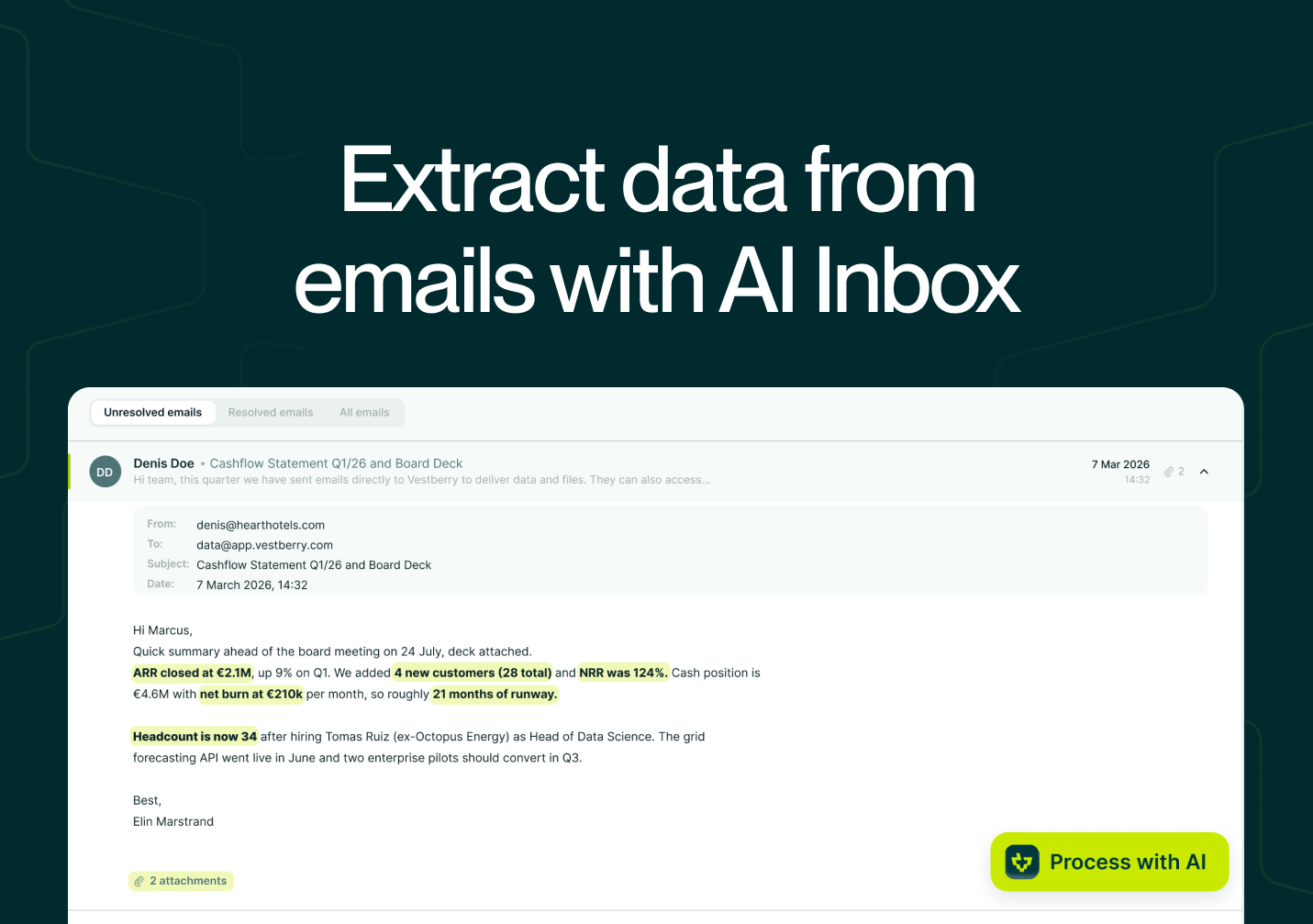
That specific pain – manual entry and email chasing – is where AI is most useful today. Vestberry's data collection uses AI to extract KPIs and financials straight from board decks, statements, and spreadsheets, while an Investee Portal and automated reminders get standardized numbers in on time.
Less chasing, cleaner inputs, more of the quarter spent on the work that actually needs judgment.
Takeaway 4: AI adoption is lopsided – the front office races ahead, the back office lags
The report scores AI adoption across the fund on a 1–5 scale, and the spread is wide:
- Investment sourcing, screening & DD – 3.4
- Engineering & infrastructure – 3.3
- Platform, talent & portfolio intelligence – 2.6
- Operations & firm management – 2.4
- Finance & fund ops – 2.2
- IR & fundraising – 2.1
- Legal & compliance – 1.8
It's worth being precise about that 2.6. It measures how far the community has adopted AI in the portfolio-intelligence part of the value chain – it is not a rating of any single product.
And it lags for a reason the report makes explicit: portfolio intelligence depends on the data foundation from Takeaway 2, so it's genuinely earlier in its curve.
The flip side is the opportunity. Deal sourcing has been automated hard; the back office – monitoring, reporting, fund operations, LP relations – is where the largest untapped gains now sit.
That's the category Vestberry is built for: turning consolidated data into portfolio intelligence (benchmarks against 100+ funds and companies, early risk signals, follow-on and scenario modeling, and an AI assistant that answers questions from your own data) and into LP reporting that goes out in a fraction of the time.
The report's own top-named AI use cases in this category – document extraction, an automated reporting and intelligence layer, and AI-powered search – map directly onto that.
Takeaway 5: What's next – agentic workflows, built on trusted data
Looking ahead, the report expects "agentic" workflows – AI that carries out multi-step tasks with a human in the loop – to become standard infrastructure. Nearly half of firms (49%) plan to hire at least one engineer in the next year, the first time engineering is set to outgrow junior-investor hiring.
But the report is careful not to oversell it. As Marek, Co-CEO of Vestberry framed it:
"Even with AI, the game hasn't changed. Reliable portfolio intelligence still requires a proper data foundation, which is why AI here is still early. But the industry is catching up fast, and I think the next big thing for portfolio management in general will be agents that handle entire VC workflows on their own, pulling from the right proprietary and third-party data sources."
The pattern across all five takeaways is the same: the AI on top is only as good as the data underneath.
Where Vestberry fits
Vestberry is the report's featured platform for portfolio management and intelligence – the category covering how funds turn raw portfolio data into monitoring, benchmarks, and reporting. The way the platform is built mirrors the report's own logic, in order:
- Single source of truth – consolidate fund, portfolio, and market data in one secure place, with a searchable audit trail and point-in-time history.
- Portfolio intelligence – benchmarks, risk signals, follow-on and waterfall scenarios, and an AI assistant that answers questions from your own data.
- Data collection – AI extraction from documents, an Investee Portal for portfolio companies, and automated reminders, so the numbers arrive clean and on time.
- Reporting & audits – institutional-grade LP reports and audit-ready records, without chasing and re-validating scattered data before you hit send.
Foundation first, AI on top. It's the same point Marek makes in the report: AI in portfolio intelligence is still early because most firms haven't built the data foundation it needs. Fix the foundation and the rest follows.
That thinking runs through the whole DDVC community, including the Top 100 thought leaders list, where Marek appears alongside people from funds we're proud to work with: Dawn Capital, Atomico, EIC Fund, Episode 1 and Giant Ventures.
Read the full report here: Data Driven VC Landscape 2026.
And if Takeaways 2 and 3 hit close to home – the scattered spreadsheets, the time lost chasing numbers – that's exactly the operational risk Vestberry is built to remove. See how it works.