
The short answer: Excel is an excellent analysis tool and a poor system of record. Once a fund passes roughly 10–15 portfolio companies or takes on institutional LPs, the practical failures – lost files, no audit trail, version conflicts, knowledge trapped in one analyst's head – start costing more than any software subscription.
The fix isn't "better spreadsheets." but a single source of truth for your portfolio data, with Excel kept for what it's genuinely great at.
Here's the honest version of that argument, including the cases where Excel is still the right choice.
Why Excel wins early (and why that's fine)
Let's be fair to the spreadsheet. In a fund's first years, Excel is usually the correct tool:
- Zero learning curve. Everyone on the team already knows it.
- Infinite flexibility. No vendor decides how you model a convertible note.
- No procurement. It's already on every laptop.
With five portfolio companies, two LPs, and one person touching the model, none of the problems below exist yet. If that's you, keep reading only to know what's coming.
Where spreadsheets break
1. Files get lost. Truth gets lost with them.
Portfolio_Master_2026_v3_FINAL_final(2).xlsx is a joke until it's your NAV bridge.
Fund data in spreadsheets lives scattered across laptops, shared drives, and email threads. Files get overwritten, saved to the wrong folder, or simply forgotten when a laptop is replaced. And with multiple copies floating around, the question that should never exist becomes routine:
"Which file is the truth?"
When two partners walk into an IC meeting with two different versions of the same portfolio overview, you don't only have a data problem – you have a decision problem. Every discussion starts with reconciling numbers instead of interpreting them.
2. No audit trail – and auditors know it
A spreadsheet can't tell you who changed a valuation, when, or why. A cell that read €4.2M last Tuesday reads €3.8M today, and there is no record of the edit, no approval step, no comment trail. Auditors treat manually maintained spreadsheets as high-risk for exactly this reason: silent formula errors, broken references, and untraceable changes.
The practical test is simple:
If an LP or auditor requests audit-ready data tomorrow, how quickly – and how confidently – can you produce it?
For most spreadsheet-run funds, the honest answer is "give us a week and cross your fingers." Audit prep becomes an annual archaeology project instead of an export.
3. The model lives in one person's head
Every long-running fund spreadsheet has an author – the one analyst who knows why column AJ references a hidden tab, and which cells must never be touched. That's key-person risk in its purest form. Processes aren't documented; they're memorized.
What happens if that person is unavailable – or resigns – during reporting season?
Teams that have lived through it describe the same thing: weeks of reverse-engineering, numbers nobody fully trusts, and an LP report that ships late. Institutional knowledge shouldn't have a single point of failure.
4. The "free" tool with a six-figure shadow
Excel's license cost is a rounding error. Its operating cost is not:
- Small funds typically sink 10–20 hours a month into manual data work – chasing portfolio company updates, re-typing numbers,.. That's 120–240 hours a year, roughly a €15–30k opportunity cost.
- Annual reporting commonly takes 2–5 weeks of collecting, validating, reformatting, and re-exporting.
- Analysts costing €60–120/hour spend up to a third of their time on data plumbing instead of deal work, portfolio support, and LP engagement.
The real question isn't "what does software cost?" It's: Do you want to reduce software cost, or total operational cost? Excel reduces the first and quietly inflates the second.
5. Complexity compounds faster than headcount
Going from 10 to 20 portfolio companies doesn't double the spreadsheet work – follow-ons, multi-currency positions, restructurings, partial exits, and per-LP reporting templates multiply against each other. Every new LP with a custom format is another template to maintain by hand, forever. Excel scales linearly at best; a fund's data complexity doesn't.
6. LPs read your reporting environment as a signal
Institutional LPs increasingly expect standardized formats (ILPA templates, consistent dashboards) and fast answers to ad-hoc questions. A manually assembled workbook isn't just slower – it signals manual, error-prone operations. Not because Excel is bad, but because LPs have seen what spreadsheet-driven reporting does to accuracy and response time.
The fix: one source of truth
Everything above is a symptom of the same root cause: your fund's data has no single home. It lives in copies.
A single source of truth means every number – valuations, KPIs, cash flows, fund metrics – exists exactly once, with permissions controlling who sees it and a full history of every change. That sounds like infrastructure plumbing, but its real payoff is decision quality:
- Meetings start from the same numbers. No reconciliation theater before the actual discussion.
- Trends become visible. When data is centralized and structured, you can compare quarters, cohorts, and funds – the analysis Excel makes technically possible but practically rare.
- Answers take minutes, not projects. An LP's ad-hoc question stops being a two-day fire drill.
- Trust compounds. The team, the partners, and your LPs stop hedging every figure with "let me double-check that."
Centralized data isn't the fancy part of a portfolio platform. It's the whole point. Better decisions are downstream of everyone reasoning from the same, current, verifiable numbers.
Excel vs. Vestberry, side by side
What changes in practice
You don't need a tour of every feature – the ones that matter are the ones that kill the failure modes above:
A permanent, permissioned home for fund data. Audit trail, access control, and one live version of every number. This alone resolves problems 1–4.
Reporting from live data, not rebuilt data. Quarterly and annual LP reports draw from the same central source – including one-click quarterly summaries from portfolio companies – instead of a fresh copy-paste marathon each cycle.
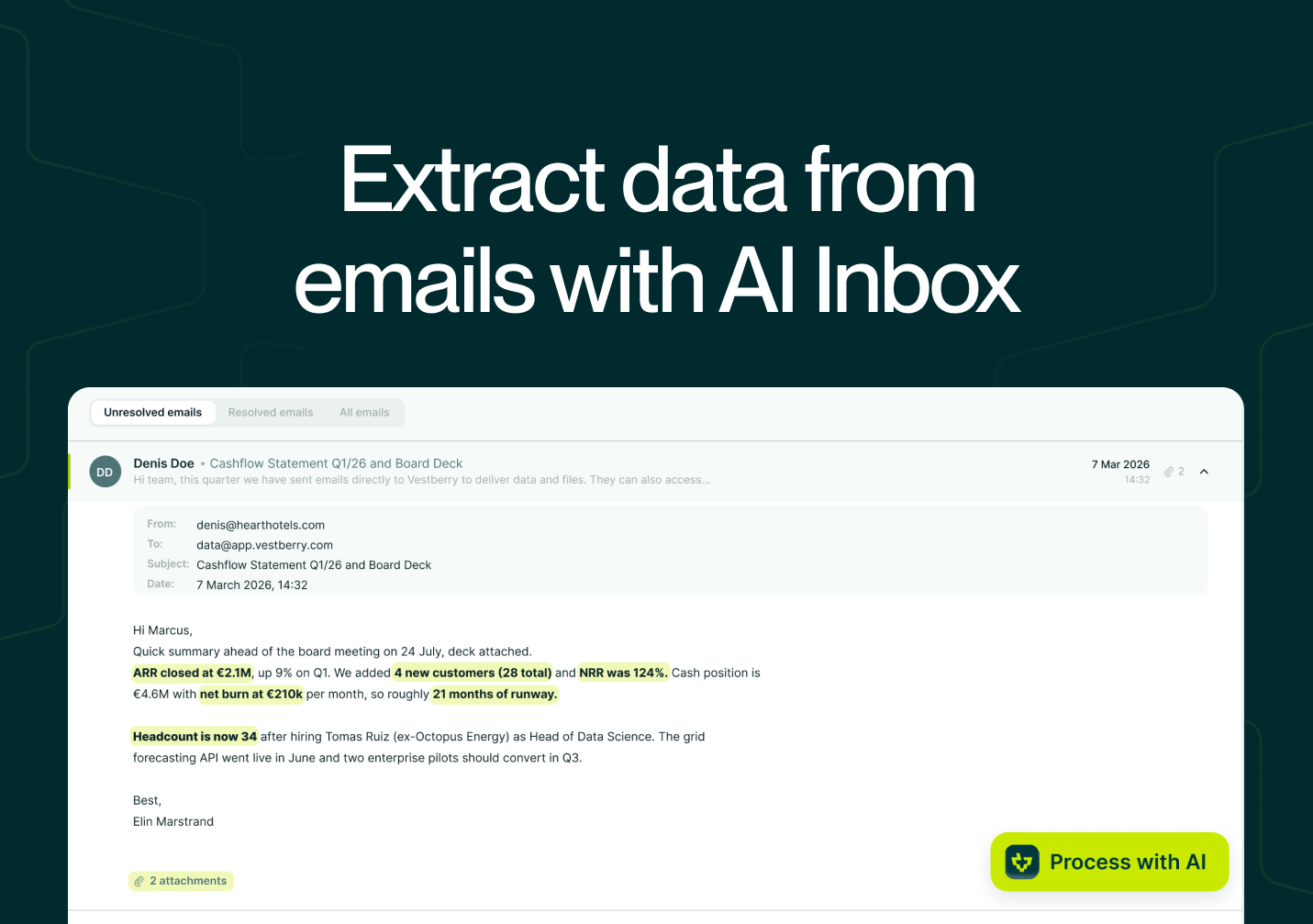
Data that arrives without chasing. Portfolio company updates sent by email get extracted automatically, including multi-file extractions for priced equity rounds. The re-typing step disappears.
Answers you can verify. When Tony (Vestberry's AI analyst) answers a question about your portfolio, every figure links back to its exact source document and paragraph. That's an evidence standard no spreadsheet formula chain – and frankly, no black-box AI – can offer.
Context, not just numbers. Fund benchmarking against the market and forecasting for follow-on capacity turn your data into the performance narrative LPs actually ask about.
"But we like Excel" – good. Keep it.
This is the part most platform pitches get wrong. You shouldn't quit Excel, and with Vestberry you don't: the Excel add-in pulls governed, always-current data from the platform directly into your workbooks.
The division of labor becomes clean:
- Vestberry is the system of record – the single source of truth, permissions, audit trail.
- Excel is your sandbox – bespoke models, one-off analyses, whatever a spreadsheet is genuinely best at.
What you lose is the manual data plumbing behind your spreadsheets. What you keep is everything you actually liked about them.
When Excel is still enough – and when it isn't
Stay in Excel if:
- You're pre-fund or running fewer than ~5 portfolio companies
- You have 1–2 LPs with no formal reporting requirements
- One person handles all fund data, and continuity risk is acceptable
It's time to switch when any of these appear:
✅ Raising fund II (historical data must survive the transition)
✅ More than 10–15 portfolio companies or ~10 LPs
✅ Your first institutional LP or ILPA-format request
✅ An audit on the calendar
✅ The person who "owns the model" could leave
✅ Reporting season consumes weeks, every time
The migration itself is a smaller lift than most teams fear – historical data onboarding is a standard, guided process, not a leap of faith.
FAQ
Is Excel good enough for a small VC fund? Often, yes – under ~5 portfolio companies and a couple of LPs, Excel's flexibility outweighs its risks. The problems in this article compound with scale; the checklist above marks the tipping point.
Do spreadsheets have an audit trail? No meaningful one. Excel doesn't record who changed a value, when, or why – which is why auditors flag manually maintained spreadsheets as high-risk and why audit prep from Excel takes so long.
Can I keep using Excel with a portfolio management platform? Yes. Vestberry's Excel add-in feeds governed, current platform data straight into your workbooks – Excel stays your analysis layer while the platform serves as the system of record.
What does "single source of truth for portfolio data" mean? Every data point exists once, in one governed place, with permissions and full change history. Everyone – partners, analysts, LP reporting – works from the same live numbers instead of competing file versions.
How lengthy is migrating fund data from Excel? Less than expected: it's a structured onboarding of your historical data, handled with the Vestberry team rather than alone. Most funds' real cost isn't migration – it's every additional quarter of manual reporting they run first.
See it on your own data
The fastest way to judge the difference isn't a feature list – it's watching your own portfolio in one place, with one version of the truth.