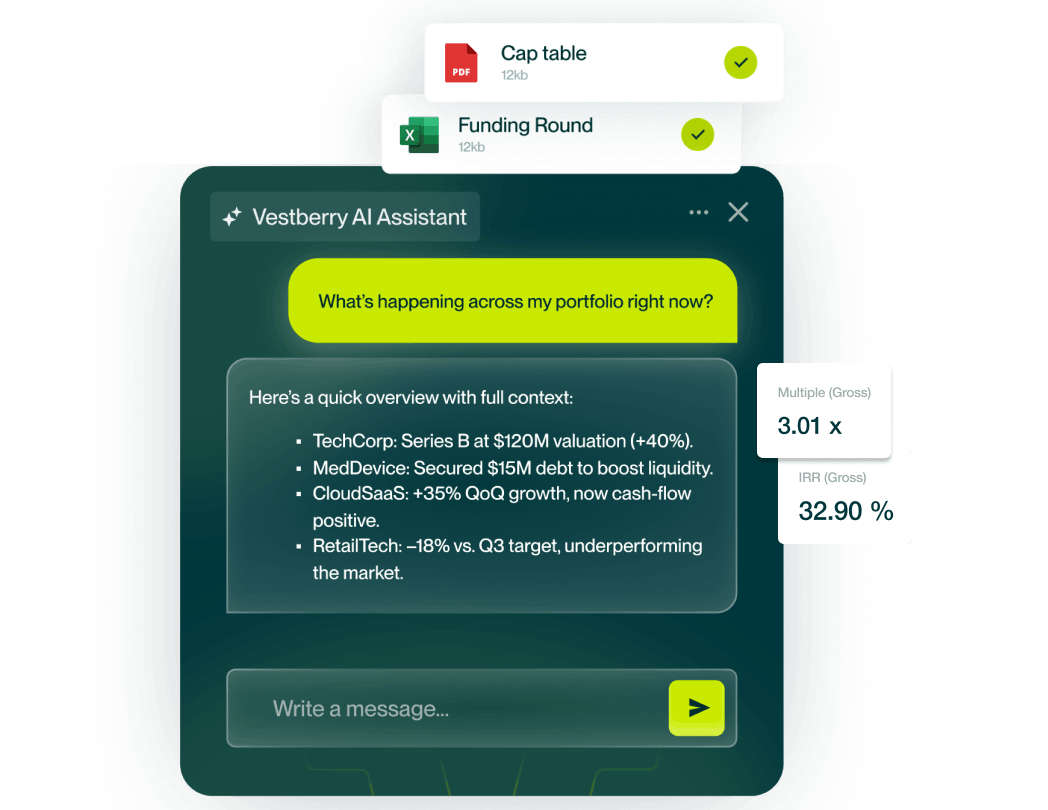
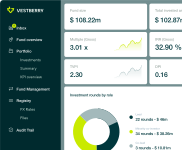

Today we're introducing Tony, Vestberry's AI for venture capital. Tony isn't a chatbot bolted onto a dashboard or a box to tick on a roadmap. It's an assistant that lives across the platform, reasons over your funds and your portfolio, and answers the questions a GP, an investment manager, or a CFO actually asks.
We want to be straight about how we think about this, because the market is full of AI that shines during a demo but disappoints in practice. That gap was never really about the model. It's about what the model can see. An agent is only as good as the context it can reason over. So from day one we've treated Tony as the product of a deep, broad, granular data model underneath it, not a clever interface laid on top. That's the part that compounds, and the part no competitor copies with a better prompt.
We're also building Tony for where this is going, not only where it is today. Right now it's a copilot you ask. Over time it becomes a system that watches your portfolio and surfaces what matters before you go looking. Then a set of specialized agents that act on your behalf, all reasoning over the same shared model. What follows is how we think about Tony, what it runs on, and where we're taking it.
The locus of value just moved
For the last decade, software competed on workflow and interface. The winners turned a painful process into a few clean clicks. That logic is now breaking down. An AI agent is, at its core, a reasoning engine pointed at a context. Point it at thin data and you get a thin answer dressed up as intelligence. Point it at a deep, granular model of your funds and your portfolio, and it becomes something you can trust with real decisions.
That changes where the durable advantage lives. It's no longer the chrome around the data. It's the data model itself: how broad it is, how fine-grained it is, and how well the pieces connect. A firm whose intelligence is built on a rich, granular model pulls steadily ahead of one whose data is shallow, siloed, or trapped in spreadsheets, no matter how good either side's AI vendor is.
The agents will commoditize. The data model won't. That conviction is the entire bet behind Tony. So here's what's underneath it.
What Tony actually runs on
The hardest truth about venture data is that most of the valuable information arrives unstructured and scattered: investment documents, portfolio documents, board decks, and a decade of context buried in emails. The first job of the engine is to turn that mess into structured, queryable data without an army of analysts doing manual entry.
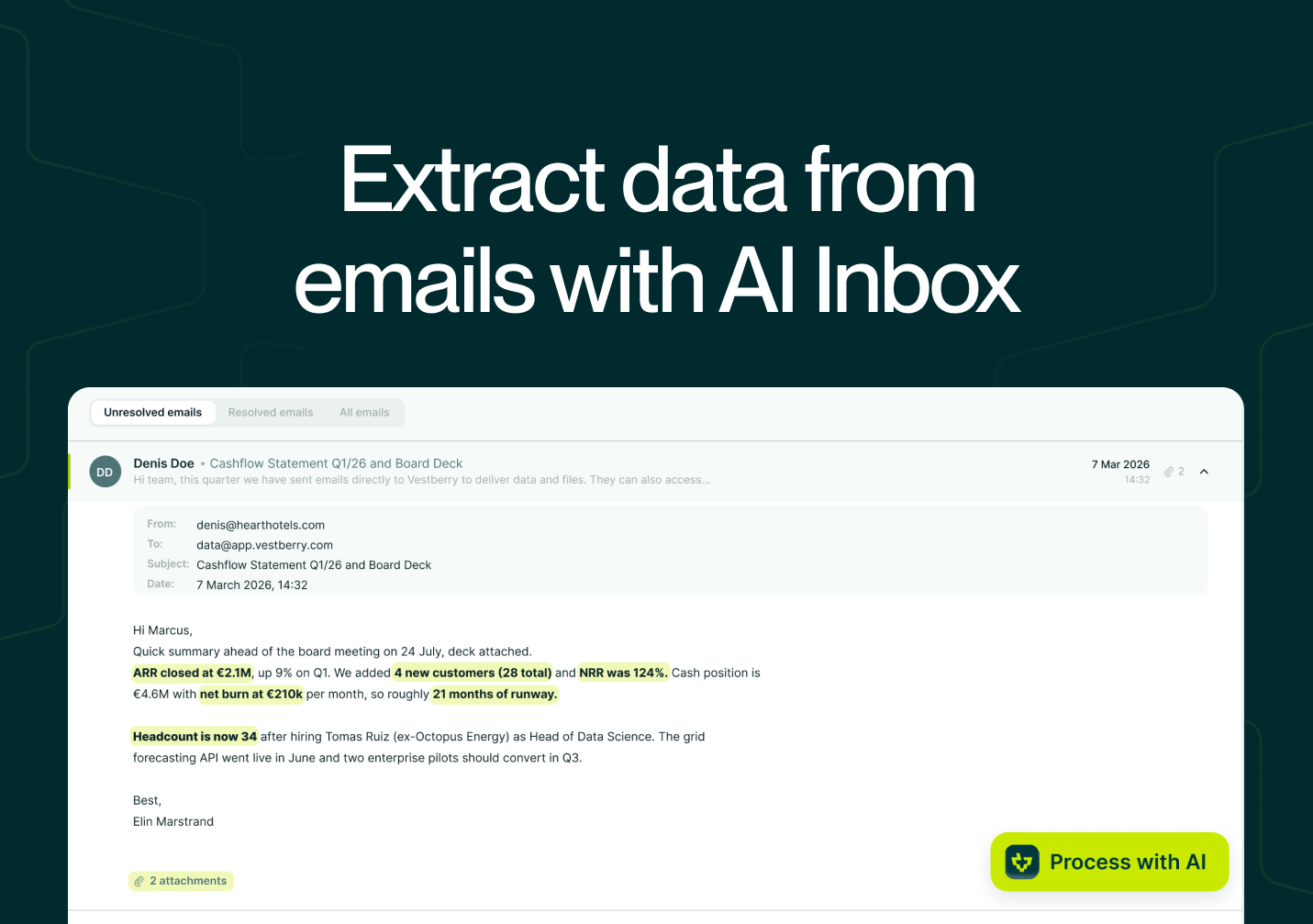
That's the bottom of the stack. Those four streams of raw material feed an AI extraction layer that reads each one and writes clean, structured records into the model. An investment agreement becomes securities, share classes, and round terms. A board deck becomes updated KPIs, financials, and qualitative notes. A portfolio document becomes cap-table and shareholder changes. An inbox becomes a timeline of context attached to the right company. Breadth normally comes at the cost of manual data entry, which is why most platforms choose between deep and broad. Because our model is fed by AI extraction, we don't make that trade. The data can be wide and fine-grained without scaling headcount alongside it.
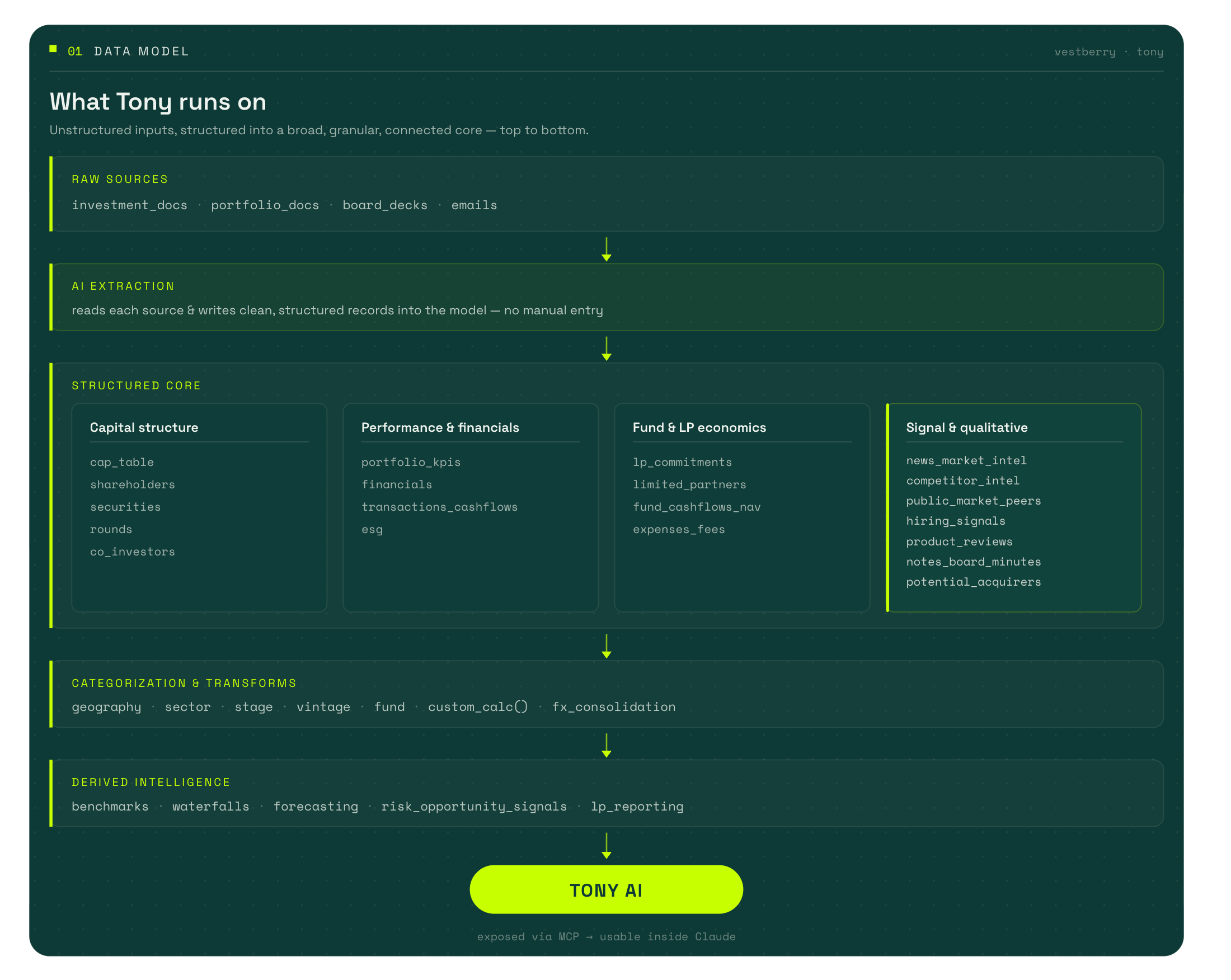
On top of that sits the structured core, the model Tony reasons over. It's worth walking through properly, because the specific data points are what separate an assistant that answers real questions from one that can only summarize. Read it not as a list of fields but as four connected layers, each one vital for a different reason.
Capital structure and ownership: cap tables, shareholders, securities, investment rounds, and co-investors. This is the layer that has to be exact, not approximate. Securities and the cap table tell Tony precisely which instruments exist and how ownership splits, by share class, with the liquidation preferences, participation rights, and conversion terms that decide who gets paid what in an exit. Investment rounds anchor each position in time and price, so entry valuations, dilution across later rounds, and markups are computed rather than estimated. Shareholders and co-investors fill in the rest of the table: who else is in, with what rights, and which syndicate partners recur across your portfolio. "We own roughly 12%" is useless when a waterfall, a pro-rata decision, or a return model depends on knowing exactly which share class converts at which preference. Granularity here is the difference between a real number and a guess.
Performance and financials: portfolio KPIs, company financials, transactions and cash flows, public market peers, and ESG, quarter by quarter at the company level. KPIs and financials are the operating reality: revenue, growth, burn, margin, runway. Captured granularly over time, they make trend detection possible. The early sign that growth is slowing or burn is creeping shows up in the slope, not in a single snapshot. Transactions and cash flows record every investment, follow-on, and distribution at the position level, which is what your cost basis, realized returns, and unrealized value are actually built from. Public market peers tie private holdings to live comparables, so a valuation reflects where the market trades today, not the last round's price. ESG belongs here too, less a nice-to-have than a reporting obligation to your own LPs, tracked at the company level alongside the financials. Together they answer the question every IC and LP eventually asks: how is this performing, and against what?
Fund and LP economics: LP commitments, limited partners, fund cash flows and NAV, and expenses and fees. This is the GP's own reality, and the layer most portfolio tools treat as an afterthought. Commitments and the LP register define who has committed what, and how much is called versus uncalled. Fund-level cash flows and NAV are the raw material for every DPI, RVPI, TVPI, and net IRR you report. Because they live in the same model as the company data, fund performance and portfolio performance reconcile instead of sitting in separate spreadsheets. Expenses and fees close the loop on net-of-everything returns and management-company economics. This is what turns "how's the portfolio doing" into "what do my LPs actually see."
The qualitative and signal layer, and this is where most platforms stop short. The numbers tell you what happened. This layer tells you why, and what's coming. It has two halves. The first is institutional memory: notes, board meeting notes, and the qualitative context attached directly to portfolio data, the reasoning that normally lives only in a partner's head or a buried doc. The why behind a markdown, the commitment a founder made last quarter, the context that makes a number mean something. Captured and linked to the company it concerns, it stops walking out the door when someone changes roles. The second is the outside world: portfolio news, competitor intelligence, market intelligence, hiring signals, product and employee reviews, and potential acquirers. This is the external context that rarely makes it into a portfolio system at all: a competitor's raise, a key engineering hire or a hiring freeze, slipping product reviews, the strategic acquirer who keeps appearing on cap tables in your space. For an agent, it's the difference between reacting to a board deck and watching the picture form around a company in real time. Potential acquirers alone turn exit planning from a phone-a-friend exercise into something grounded in who is actually active.
None of this sits off to the side. Every record in this layer is linked to the structured data it concerns, so Tony reasons across the hard numbers and the soft signals at once: this company's revenue flattened, the founder flagged a key departure in the last board meeting, two competitors just raised, and a likely acquirer just entered the category. That connection is the whole point.
Beyond reporting
The real value of a modern portfolio intelligence platform goes beyond reporting. By combining real-time portfolio data, external market signals, and AI-powered insights, venture firms can spot underperforming companies before issues escalate and recognize breakout performers early. That lets GPs focus their time and capital where it matters most: reducing portfolio risk, accelerating value creation, and improving the odds of top-quartile fund returns.
That's the line between a system of record and a system of intelligence. Reporting tells you where things stood at quarter-end. A model that reads the numbers and the external signals together tells you where to act now.
Why granularity is really about flexibility
Here's the part that's easy to miss. The reason to obsess over breadth and granularity isn't completeness for its own sake. It's flexibility.
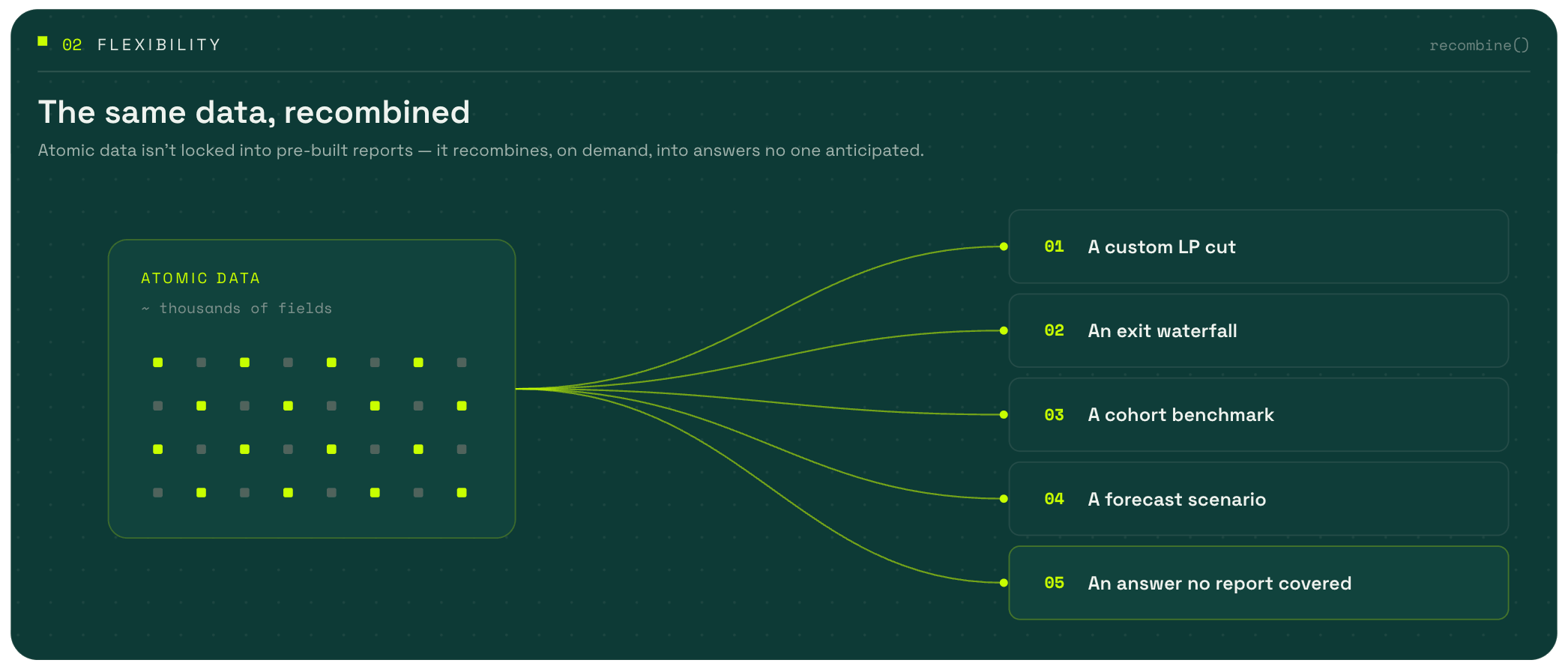
When data is atomic, you're not limited to the reports someone built in advance. Benchmarks against a peer universe of thousands of companies, exit waterfalls, forecasts, multi-currency portfolio consolidation: none of these are hardcoded outputs. They're derived from the same granular base. And because the model supports custom categorization and custom calculations on top, you can slice by geography, sector, stage, vintage, fund, or entry round, and define the transformations your firm actually thinks in. The same data reshapes to fit how your firm reasons, not how a template assumes everyone does.
The practical payoff arrives the moment someone asks a question nobody anticipated. An LP wants returns cut a way you've never reported. A partner wants to compare this cohort against that one on a metric you defined last week. A market shifts and your mandate quietly shifts with it. A firm whose intelligence is locked into fixed reports has to wait on a roadmap. A firm whose intelligence sits on a flexible, granular model just asks, and recombines the atoms it already has. In a competitive landscape, that adaptability is the edge. The questions keep changing, and only a deep model keeps answering.
Where Tony is going
Today, Tony is a copilot you ask. That's the starting line, not the destination.
The trajectory runs from reactive to proactive. Instead of waiting for the question, Tony watches the model continuously and surfaces what matters before you go looking: a covenant approaching its limit, a runway cliff forming three quarters out, a hiring freeze at a competitor, the pattern that usually precedes a down round. The richer the model, the earlier and more confidently those signals get caught.
It also runs from one assistant to a system of specialized agents, each expert in a slice of the work (monitoring, reporting, sourcing, LP relations), all reasoning over the same shared data model. That shared foundation is what makes the multiplication possible. Every new agent inherits the full context instead of starting from zero. You don't rebuild the intelligence for each task. You build it once, deeply, and point many agents at it.
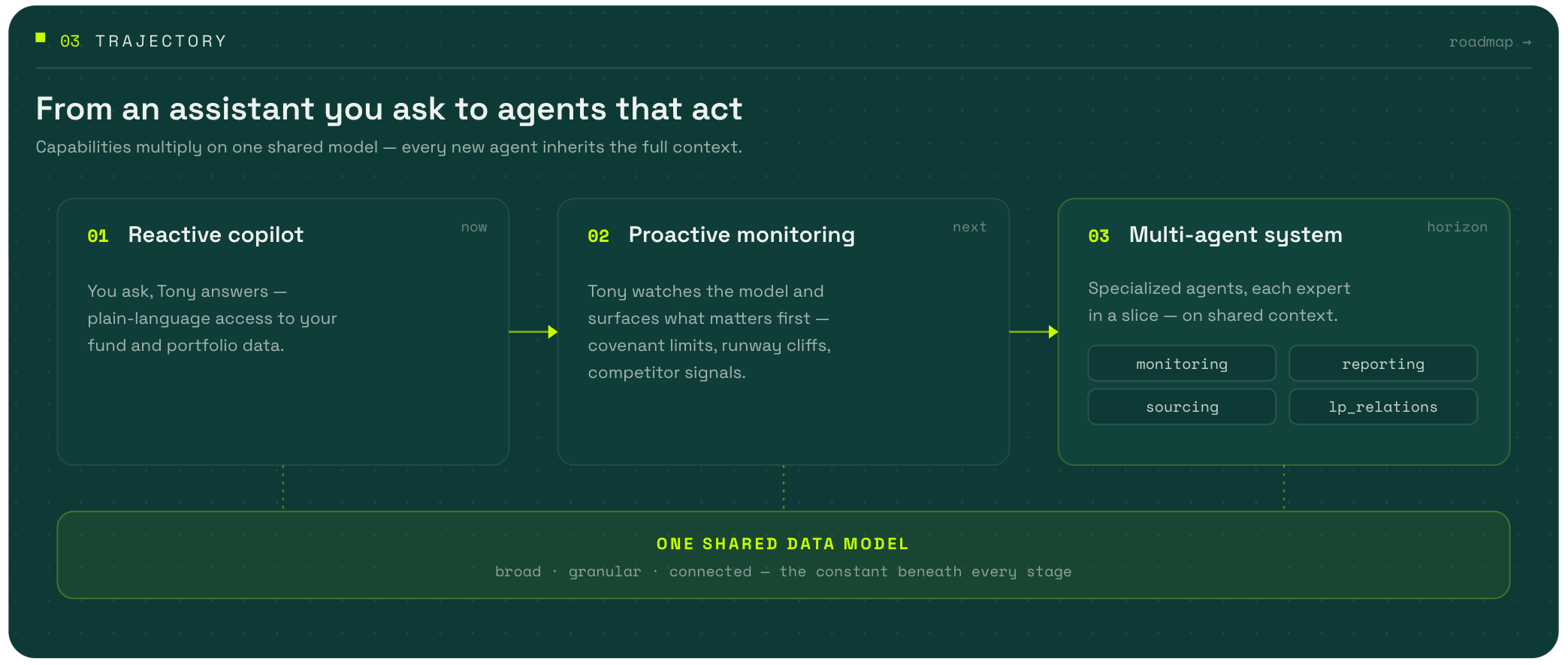
This is why the data model comes first and the agents come second. Get the foundation right, and the capabilities compound on top of it for years.
Open by design: MCP and Claude
There's a logical consequence to all of this, and I want to be explicit about it. If the durable asset is the data model, then locking it inside a single interface would be exactly the wrong instinct.
So we didn't. Vestberry's data infrastructure speaks the Model Context Protocol (MCP), the emerging open standard for giving AI systems structured access to external data and tools. In practice, that means the same broad, granular model that powers Tony can be used inside Claude and other agentic tools. You can ask questions of your live fund and portfolio data, run analysis, and build workflows on top of it, wherever you happen to work.
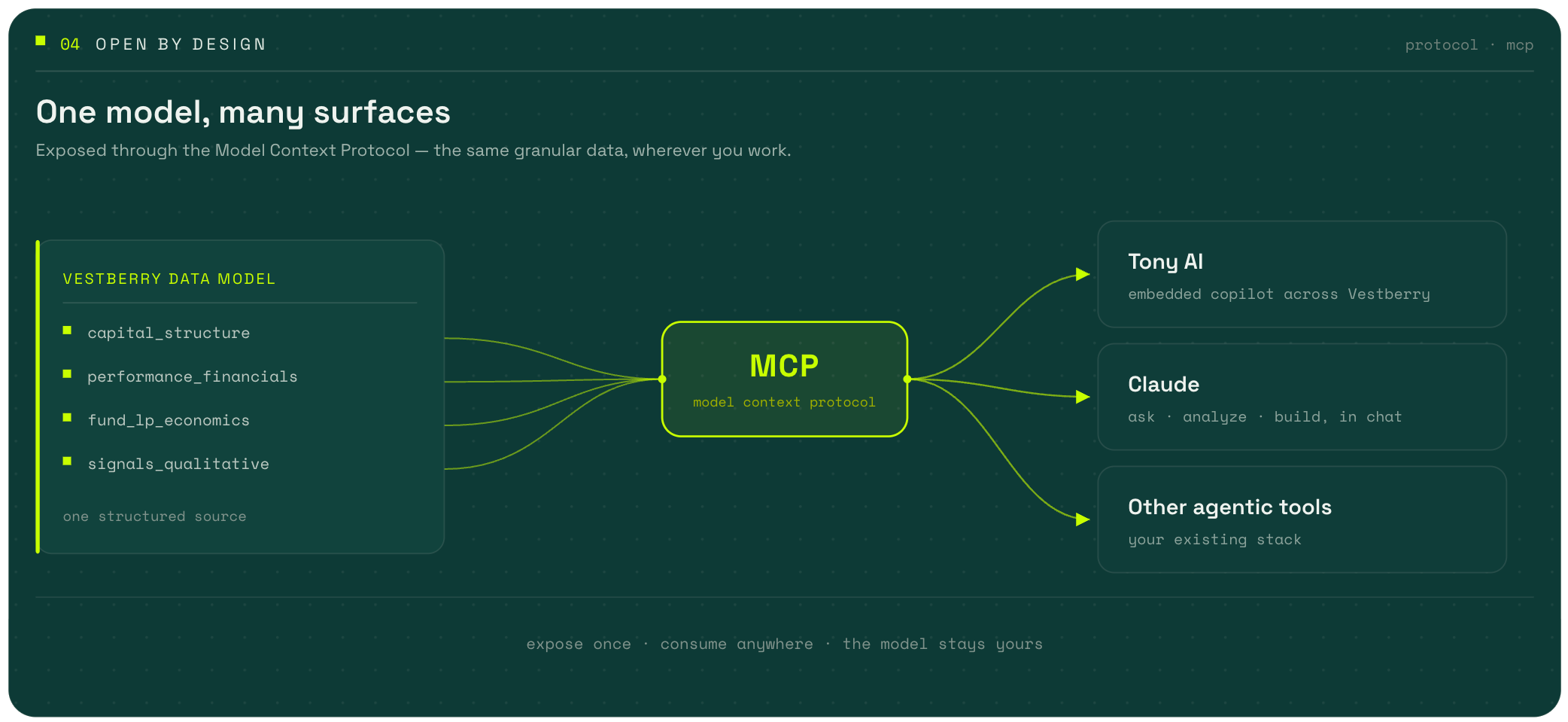
That's not us giving away the moat. It's us proving where the moat actually is. The value was never in any one interface. It's in the data model underneath, and that model stays portable, granular, and yours.
The bet
The agentic era rewards depth of context above almost everything else. The firms that treat their data as a living, granular, connected model, rather than a pile of reports and a shared drive, will hand their agents a decisive advantage. And they'll keep it as the tooling around them commoditizes.
That's the world we built Tony's engine for. The assistant is what you see. The data model is why it works.