
The short answer: build your edge, buy your system of record. Vibe-code your deal-sourcing tools and custom analytics. But your portfolio data is your track record – it has to survive an LP audit, a fund admin reconciliation, and a model update.
The real question in 2026 isn't build or buy. It's: Are you running a fund or building a product?
The temptation is real
Someone at your fund has already done this. An associate opened Claude or Cursor and had a working portfolio dashboard before the next partner meeting.
It's not fringe behavior. Per the Data Driven VC Landscape 2026, 57% of data-driven VCs are ramping up internal tools, up from 37% a year earlier. Affinity found 85% of private capital dealmakers now use AI daily.
So no – this isn't an article claiming AI-built tools don't work. The prototype is real.
But the prototype isn't the problem. The next 18 months are.
What building gets right
- One-off analyses – faster to write than to procure
- Thesis-specific tooling – no vendor will build your proprietary sourcing model
- Prototypes – test a workflow before you budget for it
- Custom agents on trusted data – the most important one, more below
Notice the pattern: every one of these assumes a reliable single source of truth already exists underneath. The trouble starts when the vibe-coded layer becomes the source of truth.
Where it breaks
1. The demo-to-production gap
A prototype feels finished in 2–3 months. Production quality takes 12–18 months – security, auditability, monitoring. That gap is where internal tools quietly die, usually two weeks before quarter-end.
And it's never one build. KPI collection first. Then reporting – second project. Then an investment ledger – third. Then multi-currency FX as the portfolio grows – fourth. Underneath it all, a database keeping every number reconciled – and someone at the fund briefing engineers on what a fund needs, instead of doing their job.
And AI isn't consistent – the same document can produce different numbers on different days. Without ongoing accuracy checks, you won't see the errors. Your LP will.
2. Your LPs will diligence this
Institutional LPs review the systems behind your numbers. A weekend build can't answer their questions:
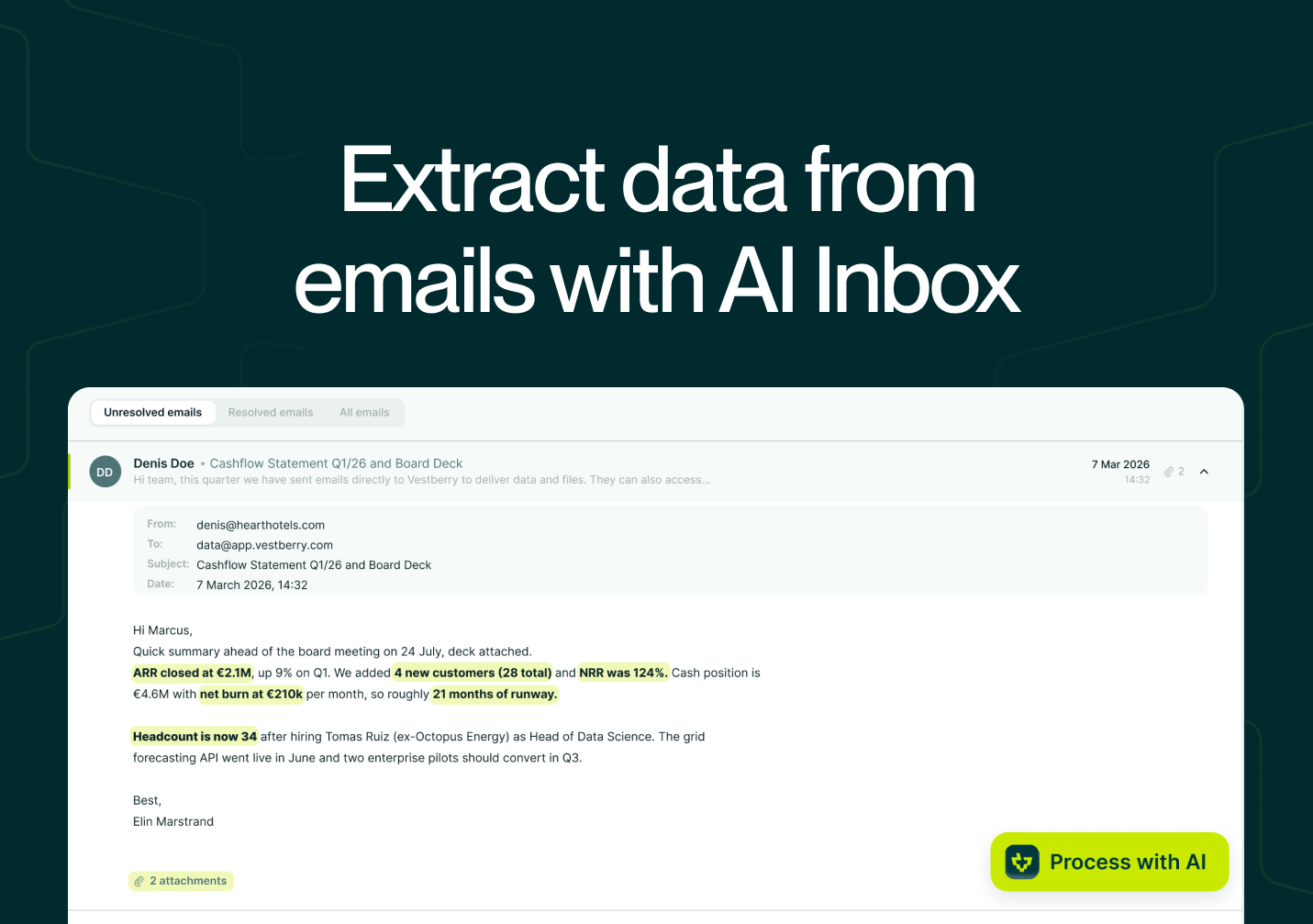
- Traceability. Where did this number come from, and from which document? A very highly desirable AI capability among customers last year – so every AI value in Vestberry carries a citation to the exact page of the source file, with human confirmation before it touches the record.
- Code security. Veracode tested 100+ LLMs: roughly 45% of AI-generated code contained at least one security flaw. That code is guarding your portfolio companies' confidential financials.
- Compliance. ISO 27001 and GDPR are a continuous six-figure annual effort. IBM's Cost of a Data Breach Report puts the average financial-services breach at over 5 million EUR in its latest edition.
- Continuity. If the analyst who built it leaves, who maintains it? An undocumented internal codebase is key-person risk in its purest form.
3. You can't prompt your way to institutional knowledge
The hard parts aren't dashboards. They're exit waterfalls, multi-tranche investments, CLN/SAFE conversions, multi-currency FX, multi-fund structures with shared portcos.
An LLM will generate plausible code for all of them – confidently, and subtly wrong. The correct logic lives in eight years of edge cases from 150+ institutional users, encoded fix by fix. And benchmarking data across thousands of companies can't be generated internally at all.
4. The maintenance iceberg
The economics beneath the table: a senior engineer costs 130k+ EUR fully loaded. Spending that on rebuilding solved table-stakes software means not spending it on the sourcing tools that actually compound into returns.
The third option: build on top of a system of record
Here's what the build-vs-buy debate misses. No internal AI tooling doesn't replace the data layer – it sits on top of it.
Vestberry exposes the audited portfolio record through an MCP server, open APIs, a native Excel add-in, and warehouse feeds. Your team points Claude – or any agent – at data that's already reconciled, permissioned, and citation-backed.
Our clients already work this way. One fund connected Claude to Vestberry via MCP to cross-check legal documents against platform records – catching missing loans and wrong currencies before quarter-end, with a human confirming every fix.
If you're the technical/finance lead thinking "I could build this" – you're right, and this is what you should build.
Seven questions before you commit to building
- Who maintains it when its author leaves the fund?
- Where does your portfolio data actually live and travel – and who holds the API keys, access controls, and audit log?
- How do you know every number is correct – no hallucinations, no silent errors? Who checks, and who re-checks when the AI model changes?
- Will your most demanding LP's diligence team accept it?
- What happens when the portfolio triples?
- Who repairs the fund admin and CRM integrations when APIs change mid-cycle?
- Is building and maintaining software the best use of your team's time and budget – or just the most interesting?
Confident answers to all seven? Build. Most funds get to question two.
FAQ
Should a VC fund build or buy portfolio monitoring software in 2026? Buy the system of record; build the proprietary layer on top if you need any. Funds generate returns from differentiated sourcing and judgment, not from re-implementing waterfall calculations.
How long does an internal portfolio monitoring tool take to build? A prototype can take weeks. Production quality takes 12–18 months, plus indefinite maintenance – commonly estimated at 3–5x the initial development cost.
Is AI-generated code safe enough for fund data? Not without vendor-grade review. Veracode found roughly 45% of AI-generated code contains at least one important security flaw.
Can we use Claude with our portfolio data? Yes – without building a platform. Vestberry's MCP server, APIs, and Excel add-in let AI assistants query your reconciled portfolio record directly.
What breaks first in a vibe-coded portfolio tool? Accuracy – and often it arrives broken. AI is built to always produce an answer, so rather than admitting it can't find a number, it will extrapolate or invent one. Nobody catches it, because the tool never flags what it isn't sure about – until a number in an LP report fails reconciliation.
What do institutional LPs look for in a portfolio data system? Traceability of every number to its source, human verification of AI values, access controls, maintained ISO/GDPR posture, and continuity that doesn't depend on one employee.
The bottom line
You can vibe-code a dashboard in a weekend. You can't vibe-code eight years of edge cases, a compliance program, or an LP's trust.
And choosing Vestberry doesn't mean giving up AI – it means getting AI that already survived the hard part. We spend months optimizing models and prompts against VC industry standards, so extraction is accurate, every number cites its source, and your source of truth never fills up with confident guesses.
Keep your team on the work that generates alpha. Put your track record on a system built to survive an audit – and if you want to build on top of it, we'll hand you the MCP server.
Book a Vestberry demo to see built-in AI running on audited portfolio data.